
Livingston County Arrest History
The Livingston County Sheriff's Office patrols all 17 towns and keeps records for arrests made by its deputies. It also operates the Livingston County Jail. Separate agencies create their own arrest and incident files. Geneseo, Dansville, and Mount Morris police hold village records; New York State Police handle their arrests; SUNY Geneseo University Police keeps campus incident records. Park Police or another agency may be responsible for events near state lands.
An arrest history is not a single local certificate. The arresting agency documents the stop or custody event. LCSO may create a separate booking file if the person enters the county jail. A town or village court records arraignment, and the prosecutor can file a charge that differs from the booking label. Fingerprints from a qualifying arrest reach the New York State Division of Criminal Justice Services, or DCJS, where later court dispositions may attach to that arrest cycle.
Livingston Arrest Records by Agency
Start with the badge, report heading, appearance ticket, or location. Livingston County does not become the custodian of every arrest merely because LCSO later handled the booking. Asking the correct department for its own report is faster and avoids a formal denial that it has no responsive record.
| Arresting agency | Livingston record route | Use it for |
|---|---|---|
| Livingston County Sheriff | LCSO FOIL request or Records Division | Deputy reports, sheriff arrests, releasable booking material |
| Geneseo Police | Official village police channel | Village incidents and arrest reports |
| Dansville Police | Official village police channel | Dansville incidents and arrest reports |
| Mount Morris Police | Official village police channel | Mount Morris incidents and arrest reports |
| New York State Police | NYSP FOIL | State highway and state-investigation records |
| SUNY Geneseo Police | University Police channel | Campus incidents and arrests |
Justice courts hold arraignment and filed-charge records, not the police narrative. After a felony transfer or indictment, Livingston County Court and County Clerk become the superior-court route. Technical aid from the LCSO Forensic Identification Unit does not change which agency owns the originating incident report.
Looking Up Livingston County Arrests
No official public Livingston County jail roster was found, so telephone and records-request channels lead the lookup. Use full name, approximate arrest or booking date, location, and the arresting agency when known. Avoid treating a missed news item or empty court search as proof that no arrest occurred.
- For current custody, call Livingston County Jail Division at 585-243-7180 and ask for releasable status using the full name and approximate booking date.
- Contact the arresting department for its incident or arrest report. A village, State Police, or campus event stays with that agency.
- For a sheriff record, call LCSO Records at 585-243-7140 or submit the official online, mail, or fax FOIL request.
- Contact the arraigning town or village court for the docket and next appearance. Ask County Clerk if an indicted felony reached superior court.
- Use OCA CHRS for a paid statewide public name and date-of-birth court search, while accounting for its limits.
- For one's own official fingerprint-supported history, use DCJS Personal Record Review through IdentoGO.
- If state-prison commitment followed, use DOCCS Incarcerated Lookup. It does not cover the Livingston County Jail roster.
The court case can supply the filed charge and final result after the arrest. The fuller Livingston County criminal court case search explains WebCrims, local clerks, superior-court files, and disposition certificates.
Livingston Arrest FOIL Request Fields
The LCSO form is the main written fallback for a sheriff arrest record that is not publicly searchable. New York Freedom of Information Law requires a grant, written denial, or acknowledgement within five business days. An acknowledgement should give an approximate response date. FOIL allows redaction or withholding for privacy, active investigations, informants, safety, youthful matters, and sealed records.
| Form field | Required | What to provide |
|---|---|---|
| Name | Yes | Requester name in two text boxes |
| Representing | No | Organization or role, when applicable |
| Address, phone, email | Unspecified | Current response and mailing contacts |
| Date | Unspecified | Form date in month/day/year format |
| Record description | Yes | Specific arrest, incident, date, place, report number, and components |
| Submit controls | Yes | Complete reCAPTCHA and submit |
Ask separately for the incident narrative, arrest record, booking information, CAD or 911 material, body-camera video, photographs, or crash record. Each component may have its own retention, redaction, and copy cost. The form says most copies carry a charge but does not publish a per-page amount, so do not assume a fee.
Inside a Livingston County Arrest Record
A requested arrest or booking record may contain both agency and jail fields, but release depends on the custodian and current legal restrictions. Livingston County has not published a public sample profile that guarantees every field. The requester should state which part of the event is needed and expect protected personal, medical, victim, juvenile, and investigative information to be redacted.
| Agency or Report Number | Connects the request to the arresting department's source file. |
|---|---|
| Arrest Date and Place | States when and where the custody event occurred. |
| Arresting Agency | Identifies the department that created the arrest report. |
| Alleged Charges | Lists citations or labels recorded at arrest or intake, subject to later change. |
| Booking Number and Time | Identifies the separate Livingston County Jail intake event, if one occurred. |
| Bail, Hold, or Release | May show custody terms and a release date available in the releasable record. |
| Photograph and Fingerprints | May exist in the booking file but are not assumed public or posted online. |
| Court or Warrant Reference | Points toward the issuing or arraigning court and its docket. |
Charges at intake reflect the information then available. A prosecutor may amend or replace them, and a court may dismiss them. Pair the arrest document with the court's final disposition before drawing any conclusion about the outcome.
Livingston Arrest Fingerprints Reach DCJS
For a qualifying fingerprintable arrest, the agency transmits prints, photographs, identity data, and charge information to DCJS. A tracking transaction helps link later court reporting to the correct arrest cycle. The court then reports a disposition, which may include conviction, dismissal, acquittal, or another result. Delays, aliases, date-of-birth variants, and missing court reports can break that chain.
DCJS Personal Record Review is not a public name portal. A person, or that person's attorney, can schedule fingerprint capture through IdentoGO and choose a suppressed or unsuppressed response. The unsuppressed version lets the subject review sealed and suppressed categories available through that process. If a court result is missing, obtain a certified disposition and use DCJS's official challenge channel rather than asking LCSO to edit the statewide rap sheet.
Arrest record flow: Agency Arrest › Jail Booking When Applicable › Fingerprint Transaction › Court Filing › Final Disposition › DCJS Update
Booking Logs and Recent Arrests
No verified official Livingston County daily booking log, mugshot gallery, public warrant list, or online jail roster was located. LCSO and village police may publish selected news releases, but those releases are not a complete arrest database. An omitted name proves nothing. A release also describes an allegation at a point in time, not the later court outcome.
Call the Jail Division for a current custody question. Submit a precise request for releasable booking material when a record copy is needed, and ask whether NYS VINE provides custody notification for the case. The Livingston County Jail, at 4 Court Street in Geneseo, has stated responsibility for up to 194 people, including pretrial detainees and people serving local sentences. State prison custody is separate and appears through DOCCS after commitment and transfer.
Livingston Arrest Records Office
LCSO Records Division is the direct sheriff-record contact. Mail a printed Records and Information Request to the division or fax it to 585-243-7104. The online form is another channel, and the counter or phone serves as a fallback. Government Center materials list ordinary county hours as 8:00 a.m. to 4:00 p.m., but callers should confirm the Records Division counter schedule.
Livingston County Sheriff Records Division
4 Court Street
Geneseo, NY 14454
585-243-7140
Fax: 585-243-7104
Provide enough detail for staff to locate the exact Livingston County arrest record. Include the event date and place, arresting agency, report or booking number when known, named record components, and whether inspection or copies are requested.
After a Livingston Arrest Case
An arrest may be followed by dismissal, conviction, jail, prison, probation, or another court result. Livingston County Probation does not operate a public arrest search. Its case files are not disclosed without a court order. The department's online form instead supports defined requests such as completion documentation and certificate-related records, using identity, offense, court, conviction, and sentence fields.
The official Livingston County Probation records request is the source shown below.
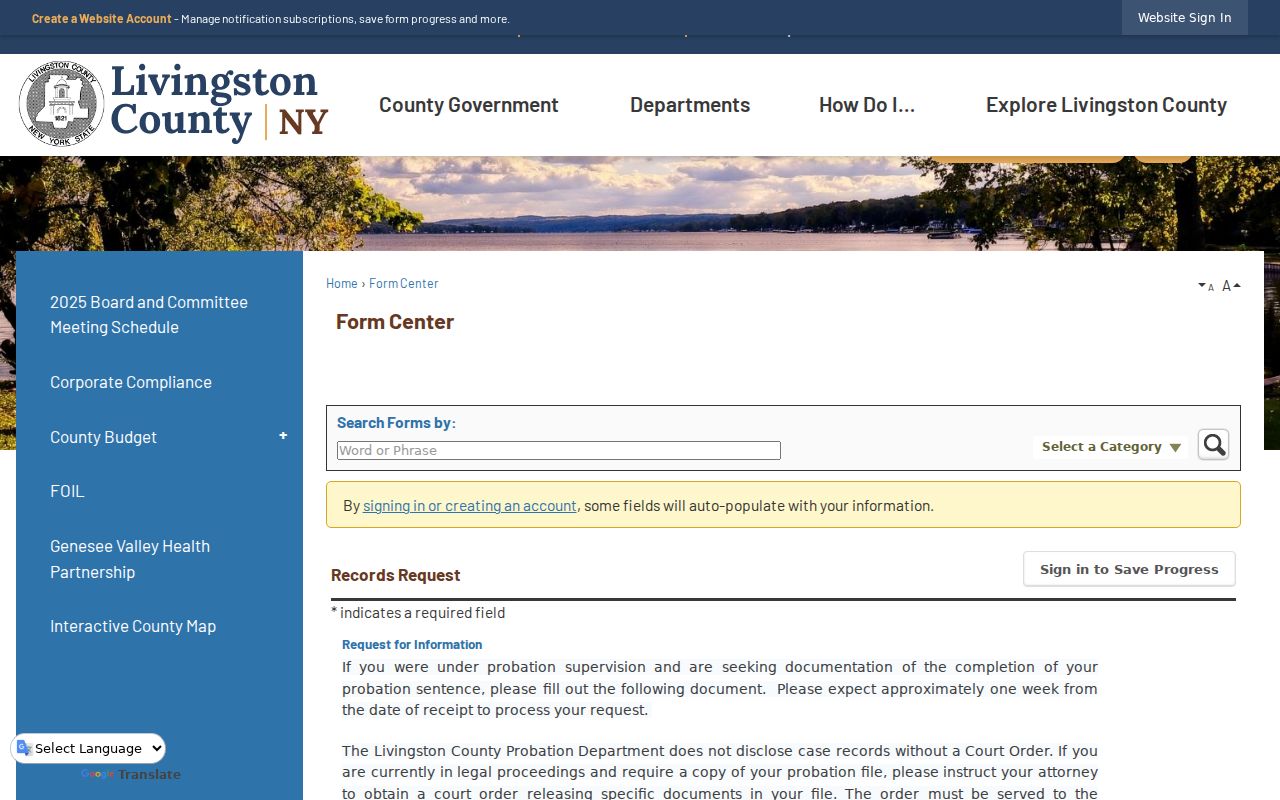
The form illustrates why post-sentence supervision is a separate record channel, not an extension of the jail booking log.
Restitution is handled through County Probation, while court fees and surcharges go through County Clerk. For parole or post-release supervision after state incarceration, use DOCCS Parolee Lookup. Recent supervision actions can lag in that system, so the listed officer or office remains the proper contact for an active case.
Arrests Are Not Convictions
A Livingston County arrest record proves that an agency documented an arrest or a jail intake. It does not prove guilt. The conviction record arises only after a guilty plea or verdict and judgment. These records are made by different offices, can carry different charges, and follow different access rules.
| Point | Arrest record | Conviction record |
|---|---|---|
| Creator | Arresting agency and, if booked, LCSO Jail | Town, village, County, or Supreme Court |
| Meaning | Documents custody and allegations at that time | Documents a court finding of guilt |
| Location | Agency report system and booking file | Court clerk, OCA data, and reported DCJS history |
| Later change | May lead to no charge, amendment, dismissal, or acquittal | May lead to sentence, appeal, correction, or lawful sealing |
A dismissal on one count does not erase the fact that a booking file was created, though sealing can sharply restrict lawful access. Conversely, a booking charge should never be substituted for the court's final judgment. Ask the court of origin for a Certificate of Disposition when the result must be clear.
Note: An arrest is not proof of guilt, and only the final court disposition establishes whether a charge produced a conviction.