
Livingston County Criminal Court Cases
Livingston County uses more than one criminal court. Town and village justice courts hear misdemeanors, violations, traffic matters, arraignments, and preliminary felony proceedings within their jurisdiction. A felony complaint can begin there before grand-jury action sends an indictment to Livingston County Court or New York Supreme Court. Those superior courts sit at 2 Court Street in Geneseo. The official Seventh Judicial District Livingston court page lists the local multi-court operation and its public contact information.
The Livingston County Clerk, at 6 Court Street, is clerk of Supreme and County Courts. The office maintains criminal indexes, indictments, filed papers, judgments, and certifications for superior-court matters. It does not absorb each town or village court's local docket. A misdemeanor that never leaves its justice court usually must be traced through that court. The court shown on an appearance ticket, accusatory instrument, or old docket entry is therefore a key search clue.
Livingston Criminal Courts by Case
The charge level and stage determine the likely custodian. This split is especially important in Livingston County, where Geneseo, Dansville, Mount Morris, and the towns each keep local justice-court records. A caller should ask whether a felony matter stayed under its local docket number, was waived for grand-jury review, or reached superior court by indictment.
| Court or office | Criminal record role | Contact point |
|---|---|---|
| Supreme and County Court | Felony and superior-court proceedings | 2 Court St., Geneseo; 585-243-7063 |
| County Clerk | Superior-court index, indictments, papers, and certified copies | 6 Court St., Geneseo; 585-243-7010 |
| Village justice courts | Local misdemeanors, violations, arraignments, and felony preliminaries | Geneseo, Dansville, or Mount Morris court clerk |
| Town justice courts | Local criminal, traffic, and preliminary proceedings | Issuing town court or NY Courts locator |
A court file and a police report answer different questions. The court has the prosecution record. The arresting agency keeps its narrative and evidence-related material. When the question concerns the initial custody event instead of the filed case, the Livingston County arrest lookup routes identify the sheriff, village police, State Police, and campus channels.
Searching Livingston County Case Records
Begin with the narrowest known court and use electronic tools as finding aids. New York eCourts WebCrims is free, but Livingston County coverage is court-dependent. A blank result is not proof that no case exists. OCA Criminal History Record Search, or CHRS, is a separate paid exact-name and date-of-birth search of public electronic criminal-court data. Its output is not certified.
- Identify the likely originating court from the arresting place, ticket, complaint, or prior notice. Call that clerk if the court is uncertain.
- Search WebCrims by defendant or case number. Use the full name and any known court or county filter that the current interface offers.
- Compare the result with the approximate filing or arraignment date. Name variants and local coverage gaps can hide a Livingston County case.
- Ask the originating clerk to inspect the docket and confirm the disposition. For superior-court files, contact County Clerk at 585-243-7010.
- Request the exact filed paper, plain copy, certified copy, or Certificate of Disposition needed. Confirm the current fee before ordering.
| WebCrims field | Type | Required | Use |
|---|---|---|---|
| Search By | Choice | Yes | Select Defendant or Case |
| Last Name | Text | Name route | Enter the defendant's last name |
| First Name | Text | Name route | Narrows people with a shared surname |
| Middle or court filters | Text or choice | No | Options vary with the live interface |
| Case Number | Text | Case route | Direct route when the docket identifier is known |
Note: WebCrims fields and Livingston court coverage can change, so confirm any result with the clerk that owns the file.
Livingston WebCrims Gaps Matter
Rural local-court reporting creates a real search trap. OCA warns that town and village dispositions are unavailable in its data for May 1991 through 2002 and limited for 2002 through 2007. Electronic transmissions can also omit a disposition or pair a name imperfectly. Livingston County has many town and village courts, so these warnings are practical, not remote.
For a statewide public search, OCA CHRS charges $95 for each exact full-name and date-of-birth combination. Each alias or alternate date requires another paid search. CHRS covers public open or pending and conviction information but excludes sealed matters, federal cases, civil and Family Court matters, youthful-offender material, and other stated categories. It also omits certain stale missing-disposition cases unless an open warrant exists. The originating Livingston County court remains the best place to settle an unclear result.
Inside a Livingston County Case File
A Livingston County criminal case file records what prosecutors filed and what the court did. It may contain a felony complaint, information, indictment, motion papers, orders, plea entries, trial events, a judgment, and sentencing material. The docket acts as the file's timeline. A Certificate of Disposition is the court's certified outcome and is often more useful than an uncertified statewide name-search report.
| Case Number and Court | Identifies the docket and the court that owns the record. |
|---|---|
| Charging Document | Shows the formal allegations filed as a complaint, information, or indictment. |
| Docket Entries | Lists appearances, motions, rulings, adjournments, pleas, and other events. |
| Hearing Dates | Shows past proceedings and a next appearance when publicly available. |
| Disposition and Judgment | Records dismissal, acquittal, conviction, or another outcome by charge. |
| Sentence and Conditions | May state jail, prison, probation, fines, surcharges, restitution, or supervision terms. |
Read charge, disposition, and sentence together. An arrest charge may be amended, reduced, dismissed, or replaced before judgment. One count's conviction does not turn every original count into a conviction. The certified court outcome is the sound source for that distinction.
Livingston Court Documents Have Custodians
The District Attorney prepares charging papers, presents grand-jury matters, and prosecutes Livingston County cases, but the filed judicial copy belongs in the court record. The clerk manages access and certification. The defense office keeps its own client material, which is not a public court archive. This division prevents wasted requests to an office that did not create or maintain the desired document.
The official source for the pictured office is the Livingston County District Attorney page.
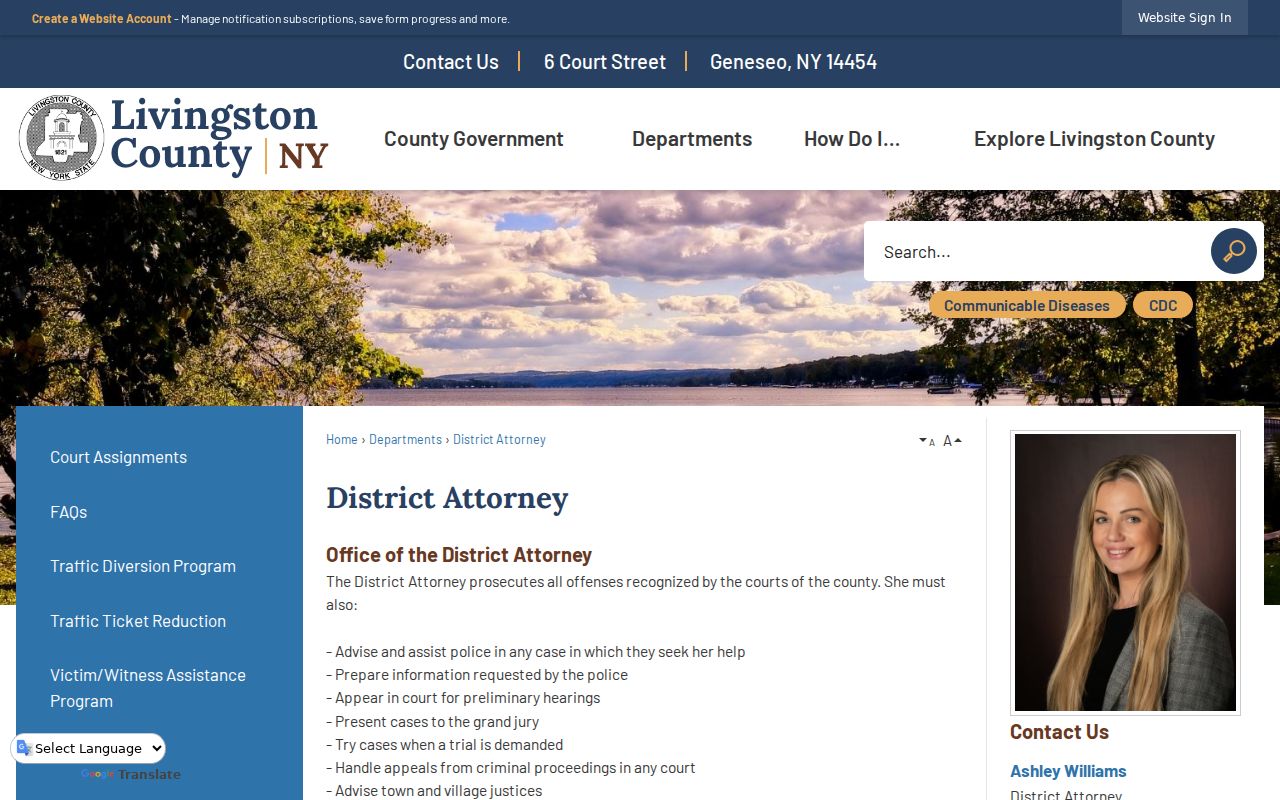
The office's courthouse location helps explain why prosecution filings can reach the court quickly, while the clerk still controls public access to the judicial file.
If a disposition never appears on a personal DCJS record, obtain the certified outcome from the court and follow the DCJS record challenge process. DCJS links fingerprint-supported arrest cycles to reported court results, but the agency does not replace the local clerk's source file.
How a Criminal Case Moves
Most local criminal files begin with an accusatory instrument and arraignment. The judge addresses counsel, plea, and release. Prosecutors and defense counsel then handle disclosure, motions, negotiations, and hearings. A felony complaint may proceed to grand-jury review, while a misdemeanor can remain in the originating justice court. A plea or trial resolves the contested charges, and a conviction leads to sentence. Appeals create a separate appellate trail.
Case flow: Charges Filed › Arraignment › Pretrial › Plea or Trial › Disposition › Sentencing
Livingston County Treatment Court can produce a different-looking docket. Its intensive program runs 12 to 24 months and uses court supervision, testing, treatment, community service, and regular contact with probation. Repeated appearances may reflect monitored participation instead of delay. Eligibility is limited, and the docket or clerk should confirm the actual case status.
Historic Livingston Criminal Court Records
Livingston County's criminal holdings extend well beyond current electronic systems. The county identifies Common Pleas records from 1821 through 1910, plus Oyer and Terminer series from portions of the nineteenth century. These records may support genealogy, local history, or research into an old prosecution. They should not be expected in WebCrims or a modern CHRS response.
Give the County Clerk or Records Management staff a party name, approximate year, likely court, and any citation found in an index. Older spelling and court-name changes can matter. County materials describe an all-criminal-actions index and inspection of unrestricted files, but the precise record location and copying method should be confirmed before a visit. Historic access still respects lawful sealing and preservation rules.
Case Record Access & Restrictions
New York court clerks provide access under judiciary rules, including Judiciary Law section 255, rather than the county's administrative FOIL channel. The clerk search and certification law works alongside sealing statutes and court orders. Livingston County says its criminal index is public and its files may be inspected, except for restricted categories such as sealed, youthful-offender, and sexual-abuse matters. Protected victim, minor, financial, and identifying details may also be withheld or redacted.
A missing public result may reflect sealing, limited electronic coverage, a name mismatch, a delayed disposition, or a case that stayed in local court. Do not infer which reason applies. Ask the originating clerk whether a public index entry exists and what proof is needed for any access available to a party. For one's own official statewide history, DCJS Personal Record Review through IdentoGO is the fingerprint-supported route.
Livingston Certificates Resolve Case Outcomes
When an online display leaves the outcome unclear, request a Certificate of Disposition from the court that entered it. The certificate can establish the final charge-level result without relying on an arrest label or an uncertified name search. For County or Supreme Court matters, contact the Livingston County Clerk. A town or village conviction begins with that local justice court.
- Disposition
- The final result for a charge, such as conviction, dismissal, or acquittal.
- Indictment
- A grand-jury accusation filed for superior-court prosecution.
- Arraignment
- The first formal court appearance addressing charges, counsel, plea, and release.
- Sealing
- A legal restriction that removes eligible records from ordinary public access.
Confirm the current certification and copy charges against the Livingston County Clerk fee schedule. The research did not isolate one universal criminal-certificate fee, so the office should quote the exact product. Clear wording matters: ask for the disposition certificate, a plain docket copy, or specified filed papers rather than requesting an undefined “full background check.”